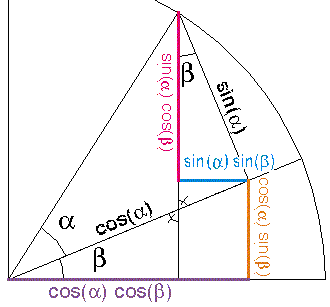
summary illustration
 

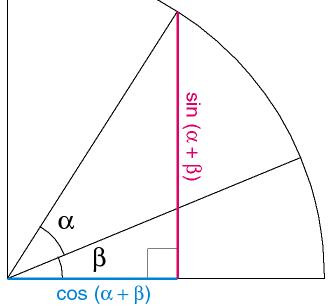
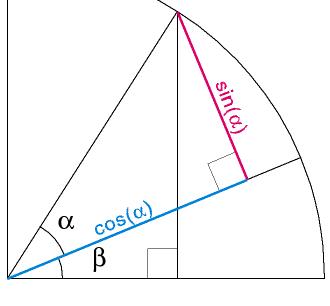
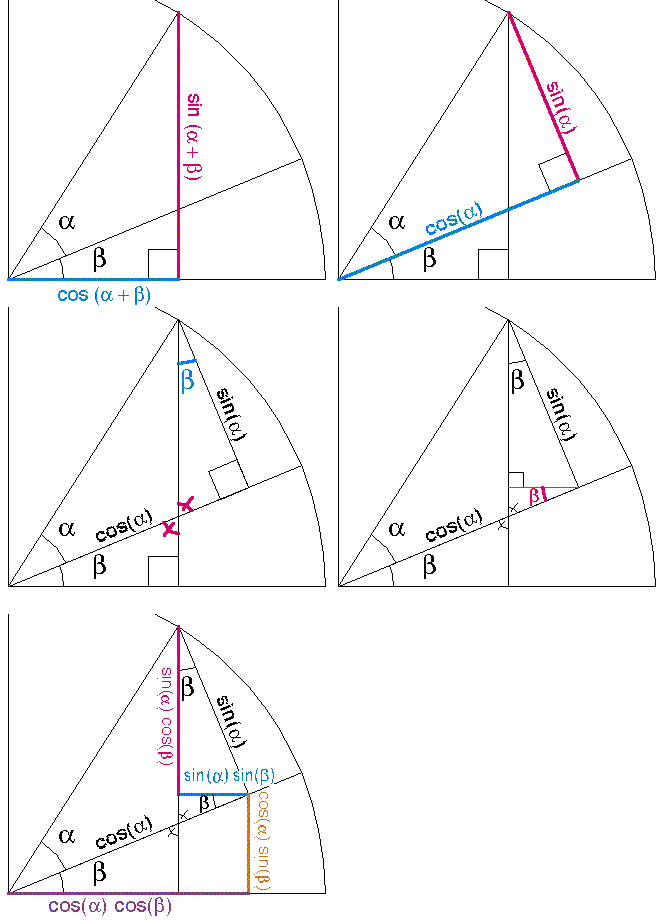
First two frames use definition of cos and sin (circle is unit circle)

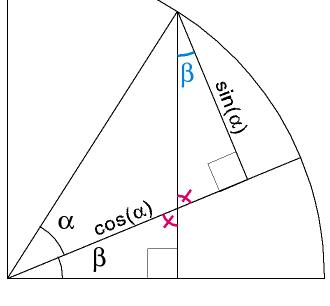
3rd frame: opposite angles are equal, Angles of a triangle add up to 180 therefore top angle of upper right triangle is Beta

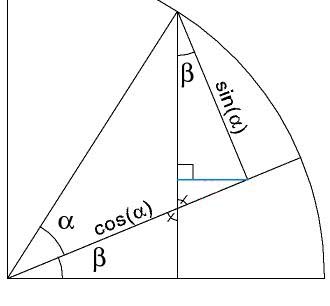
4th frame: Erect a perpendicular off of sin(alpha) line - this makes a small right triangle whose right most angle is Beta (because this angle added to the angle opposite beta = 90.


cos(a+b) = cos(a) cos(b) - sin(a) sin(b)
and
sin(a+b) = sin(a) cos(b) + sin (b) cos(a)

 Here's the same demonstration in still pictures:
Frame 1
frame 2
Step 1:  Definition of sin and cosine
Step 2:  Definition of sine and cosine
frame 3
4
Step 3:  Opposite angles are equal,
triangle angles sum to 180 degrees
Step 4: Erect a perpendicular from the vertical line.

Step 5 (to the right):
From step 4 see the upper tirangle whose hypotenuse  is sin(alpha)
The side opposite angle beta
is hypotenuse * sin(beta) or
sin(alpha) * sin(beta)
The leg adjacent to beta of the same triangle is
hypotenuse * cos(beta) or
sin(alpha) * cos(beta)
-
Then the triangle at the bottom with purple and orange legs has hypotenuse of cos(alpha).
It's  legs are
cos(alpha) * cos(beta)  (purple leg) and
cos(alpha) * sin(beta)  (orange leg).
-
Adding the red and orange lines gives the vertical distance and subtracting the green from the purple line gives the horizontal distance.
Summary illustration
-
Hop's Other trigonometry Pages
-
Triangle angles add up to 180 degrees
What is sine and cosine?
Angle measure in radians, generating a sine wave
Sin(h)/h approaches 1 as h approaches zero
Pythagorean Theorem
-
Hop's Gallery. Please check out my artwork!